Taxonomy
Taxonomy control lets you search and select terms from any WordPress taxonomy (categories, tags, or custom taxonomies).
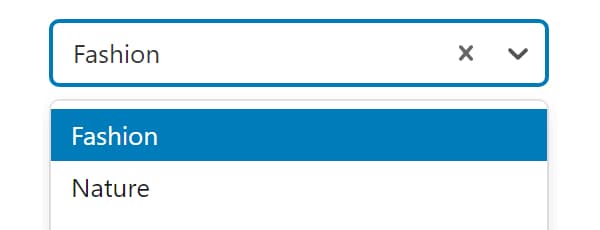
Only taxonomies registered with show_in_rest => true will appear in the control. If your custom taxonomy is not showing up, add this parameter:
register_taxonomy('your_taxonomy', 'post', [
    // ... other parameters
    'show_in_rest' => true,
]);
Control Settings
- Taxonomy (
taxonomy) - where the terms come from,categoryby default. The list holds every taxonomy the REST API exposes - Appearance (
taxonomy_appearance) -Selectby default, a searchable dropdown.Radioputs one input per term on screen and is labelledCheckboxwhile Multiple is on.Token Fieldtakes terms as removable tokens - Output Format (
taxonomy_output_format) - what the control stores.Term Slugby default, orTerm ID, orTerm Object, which stores the ID and turns it into aWP_Termwhen the block renders - Multiple (
multiple) - off by default. Stores an array of terms instead of one
Output Format decides what is written into the block, not how an existing value is read, so blocks saved before you switch from Term Slug to Term ID keep their slugs until the term is picked again.
Usage Examples
Basic Usage (Term Slug)
<?php
$term = get_term_by('slug', $attributes['control_name'], 'category');
if ($term && !is_wp_error($term)) {
    echo '<span class="term">' . esc_html($term->name) . '</span>';
}
?>
Multiple Terms
<?php if ($attributes['control_name']) : ?>
    <ul class="terms-list">
        <?php foreach($attributes['control_name'] as $term_slug) :
            $term = get_term_by('slug', $term_slug, 'category');
            if ($term && !is_wp_error($term)) : ?>
                <li class="term-<?php echo esc_attr($term->slug); ?>">
                    <?php echo esc_html($term->name); ?>
                </li>
            <?php endif;
        endforeach; ?>
    </ul>
<?php endif; ?>
Using Term Object
<?php if ($attributes['control_name']) : ?>
    <div class="term-<?php echo esc_attr($attributes['control_name']->slug); ?>">
        <h4><?php echo esc_html($attributes['control_name']->name); ?></h4>
        <p><?php echo esc_html($attributes['control_name']->description); ?></p>
    </div>
<?php endif; ?>
Handlebars Usage
Set Output Format to Term Object when using Handlebars templates.
<div class="term-{{control_name.slug}}">
  {{control_name.name}}
</div><ul class="terms-list">
{{#each control_name}}
<li class="term-{{this.slug}}">
{{this.name}}
</li>
{{/each}}
</ul>Post Meta
<?php
$term_slug = get_lzb_meta('control_meta_name');
if ($term_slug) {
    $term = get_term_by('slug', $term_slug, 'category');
    if ($term && !is_wp_error($term)) {
        echo '<span class="term">' . esc_html($term->name) . '</span>';
    }
}
?>
Use Term Object format to access all term data without additional database queries.